Artificial intelligence is transforming the marketing landscape faster than ever. From content generation and customer segmentation to predictive analytics and chatbots, AI tools are becoming an essential part of every marketer’s toolkit.
But one question continues to dominate industry discussions: Can AI Replace Digital Marketers?
The short answer is no—but the full answer is more nuanced.
AI is changing how digital marketing works, automating repetitive tasks and improving efficiency. However, successful marketing still relies heavily on creativity, emotional intelligence, strategic thinking, and human connection.
In this article, we’ll explore what AI can and cannot do, how it’s reshaping the marketing industry, and what digital marketers need to do to stay relevant in an AI-driven world.
The Rise of AI in Digital Marketing
AI is no longer a futuristic concept. It’s already embedded in many marketing platforms and workflows.
Today, businesses use AI for:
- Generating content ideas
- Analyzing customer behavior
- Running personalized email campaigns
- Predicting purchasing patterns
- Managing paid advertising campaigns
- Creating chatbots for customer support
- Automating social media scheduling
Popular AI-powered tools have made advanced marketing capabilities accessible to businesses of all sizes.
Examples include:
- Content generation platforms
- Predictive analytics software
- Marketing automation systems
- AI chatbots
- SEO optimization tools
As these technologies continue to evolve, concerns about job displacement are understandable.
However, understanding the strengths and limitations of AI reveals a different story.
What AI Does Better Than Humans
AI excels at tasks that involve processing large amounts of data quickly and accurately.
Data Analysis at Scale
AI can analyze millions of data points in seconds, identifying trends that humans might overlook.
For example, AI can:
- Track customer behavior across multiple channels
- Predict future buying patterns
- Identify high-performing campaigns
- Optimize ad spending in real time
Automation of Repetitive Tasks
Routine activities consume a significant portion of a marketer’s time.
AI can automate:
- Email scheduling
- Social media posting
- Keyword research
- A/B testing
- Customer segmentation
- Reporting and analytics
This allows marketers to focus on higher-value activities.
Personalization
Modern consumers expect personalized experiences.
AI enables businesses to deliver:
- Customized product recommendations
- Personalized email content
- Dynamic website experiences
- Targeted advertisements
Large brands already rely heavily on AI to improve customer experiences.
Faster Content Production
AI tools can generate:
- Blog outlines
- Social media captions
- Product descriptions
- Email drafts
- Ad copy variations
While human oversight remains essential, AI significantly speeds up content creation.
What AI Cannot Replace
Despite its capabilities, AI has important limitations.
Human Creativity
Great marketing goes beyond data.
It requires:
- Original ideas
- Storytelling
- Brand personality
- Cultural awareness
- Emotional resonance
AI can mimic patterns from existing content, but it cannot create truly original experiences rooted in human understanding.
Strategic Thinking
Successful marketing requires long-term vision.
Digital marketers make decisions based on:
- Business goals
- Market conditions
- Competitive positioning
- Customer psychology
AI provides insights, but humans determine the direction.
Emotional Intelligence
Understanding human emotions is at the core of effective marketing.
Consumers buy based on feelings, trust, and relationships.
Marketers understand:
- Audience pain points
- Customer motivations
- Cultural nuances
- Brand sentiment
AI struggles to interpret these complexities accurately.
Ethical Decision-Making
Marketing decisions often involve ethical considerations.
Questions about privacy, transparency, and brand reputation require human judgment.
AI cannot replace accountability.
Human vs. AI: A Better Way to Think About It
Instead of asking, “Can AI Replace Digital Marketers?” consider this question:
How can digital marketers work alongside AI?
The future belongs to marketers who know how to use AI strategically.
Think of AI as a powerful assistant rather than a replacement.
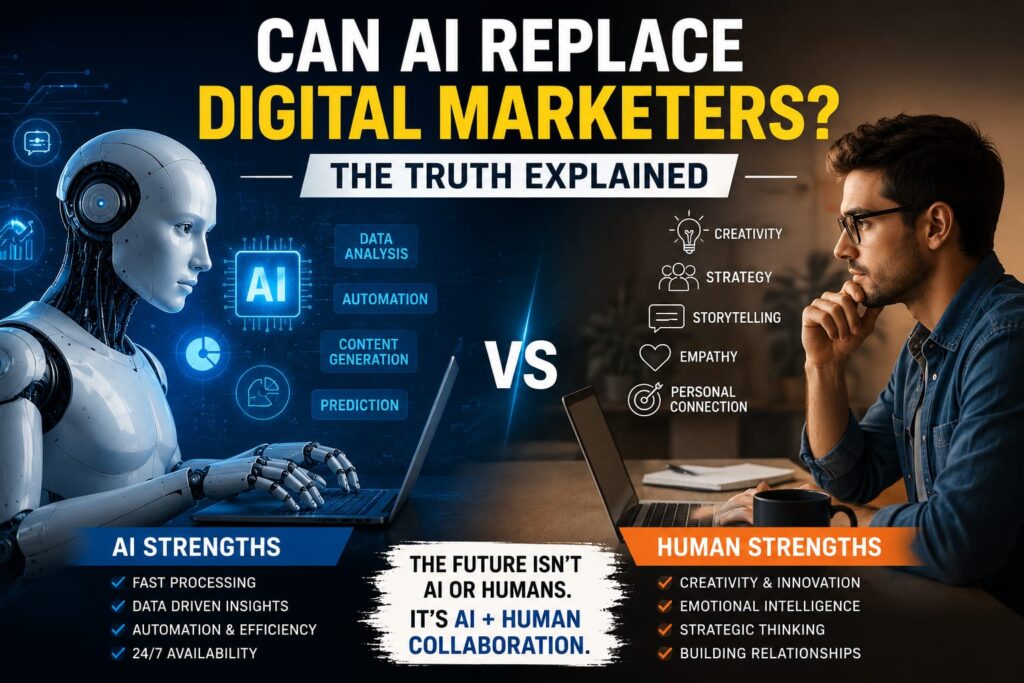
AI Handles:
- Data processing
- Automation
- Content drafts
- Predictive analytics
- Campaign optimization
Humans Handle:
- Strategy
- Creativity
- Brand building
- Relationship management
- Decision-making
The combination of human expertise and AI efficiency creates stronger marketing outcomes.
Which Digital Marketing Roles Are Most Affected?
Not all marketing roles will experience AI in the same way.
High Automation Potential
Roles involving repetitive tasks may see significant changes.
Examples include:
- Basic content writing
- Data reporting
- Email automation
- PPC bid management
- Social media scheduling
Lower Automation Potential
Roles requiring creativity and strategic thinking are less vulnerable.
Examples include:
- Brand strategists
- Marketing consultants
- Creative directors
- Customer experience specialists
- SEO strategists
- Community managers
The future isn’t about job elimination—it’s about job evolution.
How AI Is Transforming SEO
SEO professionals are already experiencing the impact of AI.
AI tools can assist with:
- Keyword clustering
- Competitor analysis
- Content optimization
- Search intent analysis
- Technical SEO audits
However, successful SEO still depends on:
- Understanding audience needs
- Creating valuable content
- Building topical authority
- Developing content strategies
- Earning trust and credibility
Google continues to prioritize high-quality, people-first content that demonstrates expertise and authenticity.
Following EEAT principles—Experience, Expertise, Authoritativeness, and Trustworthiness—is more important than ever.
Real-World Examples of AI in Marketing
Many companies are already integrating AI into their marketing strategies.
E-commerce Brands
Online retailers use AI for:
- Personalized product recommendations
- Dynamic pricing
- Cart abandonment emails
Streaming Platforms
Streaming services analyze user behavior to recommend content and increase engagement.
B2B Companies
B2B marketers leverage AI for:
- Lead scoring
- Sales forecasting
- Automated nurturing campaigns
In every case, human marketers oversee strategy and ensure brand consistency.
Skills Digital Marketers Need in the AI Era
To remain competitive, marketers should develop skills that complement AI.
Focus on improving:
- Strategic thinking
- Brand storytelling
- Customer psychology
- Data interpretation
- Prompt engineering
- AI tool proficiency
- Content strategy
- Creative problem-solving
- Communication skills
- Ethical decision-making
The most valuable marketers will be those who combine technology with human insight.
Expert Tips
1. Use AI to Save Time, Not Replace Thinking
Allow AI to automate repetitive tasks, but maintain human oversight for strategy and quality control.
2. Verify Every AI Output
AI-generated content can contain inaccuracies.
Always fact-check data, statistics, and recommendations.
3. Develop a Unique Brand Voice
AI can generate content quickly, but only humans can create a memorable brand identity.
4. Focus on Customer Experience
People remember experiences, not algorithms.
Build authentic relationships with your audience.
5. Keep Learning
AI tools evolve rapidly.
Stay updated with emerging technologies, industry trends, and platform changes.
The Future of Digital Marketing: Collaboration, Not Competition
AI will continue to reshape the marketing industry.
Routine tasks will become increasingly automated.
Data-driven decisions will become more accurate.
Personalization will become more sophisticated.
However, businesses will always need marketers who can:
- Understand people
- Build trust
- Create compelling stories
- Make strategic decisions
- Drive innovation
The marketers who embrace AI will outperform those who ignore it.
Conclusion: Will AI Replace Digital Marketers?
So, can AI replace digital marketers?
Not entirely.
AI can automate processes, improve efficiency, and enhance decision-making. But it cannot replicate the human qualities that make marketing effective—creativity, empathy, intuition, and strategic thinking.
The future belongs to marketers who view AI as a partner rather than a threat.
If you’re a digital marketer, now is the time to learn AI tools, strengthen your strategic skills, and focus on the areas where humans create the most value.
Embrace the change, adapt continuously, and you’ll remain indispensable in the evolving marketing landscape.
The Rise of AI in Digital Marketing
AI is no longer a futuristic concept. It’s already embedded in many marketing platforms and workflows.
Today, businesses use AI for:
- Generating content ideas
- Analyzing customer behavior
- Running personalized email campaigns
- Predicting purchasing patterns
- Managing paid advertising campaigns
- Creating chatbots for customer support
- Automating social media scheduling
Popular AI-powered tools have made advanced marketing capabilities accessible to businesses of all sizes.
Examples include:
- Content generation platforms
- Predictive analytics software
- Marketing automation systems
- AI chatbots
- SEO optimization tools
As these technologies continue to evolve, concerns about job displacement are understandable.
However, understanding the strengths and limitations of AI reveals a different story.
What AI Does Better Than Humans
AI excels at tasks that involve processing large amounts of data quickly and accurately.
Data Analysis at Scale
AI can analyze millions of data points in seconds, identifying trends that humans might overlook.
For example, AI can:
- Track customer behavior across multiple channels
- Predict future buying patterns
- Identify high-performing campaigns
- Optimize ad spending in real time
Automation of Repetitive Tasks
Routine activities consume a significant portion of a marketer’s time.
AI can automate:
- Email scheduling
- Social media posting
- Keyword research
- A/B testing
- Customer segmentation
- Reporting and analytics
This allows marketers to focus on higher-value activities.
Personalization
Modern consumers expect personalized experiences.
AI enables businesses to deliver:
- Customized product recommendations
- Personalized email content
- Dynamic website experiences
- Targeted advertisements
Large brands already rely heavily on AI to improve customer experiences.
Faster Content Production
AI tools can generate:
- Blog outlines
- Social media captions
- Product descriptions
- Email drafts
- Ad copy variations
While human oversight remains essential, AI significantly speeds up content creation.
What AI Cannot Replace
Despite its capabilities, AI has important limitations.
Human Creativity
Great marketing goes beyond data.
It requires:
- Original ideas
- Storytelling
- Brand personality
- Cultural awareness
- Emotional resonance
AI can mimic patterns from existing content, but it cannot create truly original experiences rooted in human understanding.
Strategic Thinking
Successful marketing requires long-term vision.
Digital marketers make decisions based on:
- Business goals
- Market conditions
- Competitive positioning
- Customer psychology
AI provides insights, but humans determine the direction.
Emotional Intelligence
Understanding human emotions is at the core of effective marketing.
Consumers buy based on feelings, trust, and relationships.
Marketers understand:
- Audience pain points
- Customer motivations
- Cultural nuances
- Brand sentiment
AI struggles to interpret these complexities accurately.
Ethical Decision-Making
Marketing decisions often involve ethical considerations.
Questions about privacy, transparency, and brand reputation require human judgment.
AI cannot replace accountability.
Human vs. AI: A Better Way to Think About It
Instead of asking, “Can AI Replace Digital Marketers?” consider this question:
How can digital marketers work alongside AI?
The future belongs to marketers who know how to use AI strategically.
Think of AI as a powerful assistant rather than a replacement.
AI Handles:
- Data processing
- Automation
- Content drafts
- Predictive analytics
- Campaign optimization
Humans Handle:
- Strategy
- Creativity
- Brand building
- Relationship management
- Decision-making
The combination of human expertise and AI efficiency creates stronger marketing outcomes.
Which Digital Marketing Roles Are Most Affected?
Not all marketing roles will experience AI in the same way.
High Automation Potential
Roles involving repetitive tasks may see significant changes.
Examples include:
- Basic content writing
- Data reporting
- Email automation
- PPC bid management
- Social media scheduling
Lower Automation Potential
Roles requiring creativity and strategic thinking are less vulnerable.
Examples include:
- Brand strategists
- Marketing consultants
- Creative directors
- Customer experience specialists
- SEO strategists
- Community managers
The future isn’t about job elimination—it’s about job evolution.
How AI Is Transforming SEO
SEO professionals are already experiencing the impact of AI.
AI tools can assist with:
- Keyword clustering
- Competitor analysis
- Content optimization
- Search intent analysis
- Technical SEO audits
However, successful SEO still depends on:
- Understanding audience needs
- Creating valuable content
- Building topical authority
- Developing content strategies
- Earning trust and credibility
Google continues to prioritize high-quality, people-first content that demonstrates expertise and authenticity.
Following EEAT principles—Experience, Expertise, Authoritativeness, and Trustworthiness—is more important than ever.
Real-World Examples of AI in Marketing
Many companies are already integrating AI into their marketing strategies.
E-commerce Brands
Online retailers use AI for:
- Personalized product recommendations
- Dynamic pricing
- Cart abandonment emails
Streaming Platforms
Streaming services analyze user behavior to recommend content and increase engagement.
B2B Companies
B2B marketers leverage AI for:
- Lead scoring
- Sales forecasting
- Automated nurturing campaigns
In every case, human marketers oversee strategy and ensure brand consistency.
Skills Digital Marketers Need in the AI Era
To remain competitive, marketers should develop skills that complement AI.
Focus on improving:
- Strategic thinking
- Brand storytelling
- Customer psychology
- Data interpretation
- Prompt engineering
- AI tool proficiency
- Content strategy
- Creative problem-solving
- Communication skills
- Ethical decision-making
The most valuable marketers will be those who combine technology with human insight.
Expert Tips
1. Use AI to Save Time, Not Replace Thinking
Allow AI to automate repetitive tasks, but maintain human oversight for strategy and quality control.
2. Verify Every AI Output
AI-generated content can contain inaccuracies.
Always fact-check data, statistics, and recommendations.
3. Develop a Unique Brand Voice
AI can generate content quickly, but only humans can create a memorable brand identity.
4. Focus on Customer Experience
People remember experiences, not algorithms.
Build authentic relationships with your audience.
5. Keep Learning
AI tools evolve rapidly.
Stay updated with emerging technologies, industry trends, and platform changes.
The Future of Digital Marketing: Collaboration, Not Competition
AI will continue to reshape the marketing industry.
Routine tasks will become increasingly automated.
Data-driven decisions will become more accurate.
Personalization will become more sophisticated.
However, businesses will always need marketers who can:
- Understand people
- Build trust
- Create compelling stories
- Make strategic decisions
- Drive innovation
The marketers who embrace AI will outperform those who ignore it.
Conclusion: Will AI Replace Digital Marketers?
So, can AI replace digital marketers?
Not entirely.
AI can automate processes, improve efficiency, and enhance decision-making. But it cannot replicate the human qualities that make marketing effective—creativity, empathy, intuition, and strategic thinking.
The future belongs to marketers who view AI as a partner rather than a threatThe Rise of AI in Digital Marketing
AI is no longer a futuristic concept. It’s already embedded in many marketing platforms and workflows.
Today, businesses use AI for:
- Generating content ideas
- Analyzing customer behavior
- Running personalized email campaigns
- Predicting purchasing patterns
- Managing paid advertising campaigns
- Creating chatbots for customer support
- Automating social media scheduling
Popular AI-powered tools have made advanced marketing capabilities accessible to businesses of all sizes.
Examples include:
- Content generation platforms
- Predictive analytics software
- Marketing automation systems
- AI chatbots
- SEO optimization tools
As these technologies continue to evolve, concerns about job displacement are understandable.
However, understanding the strengths and limitations of AI reveals a different story.
What AI Does Better Than Humans
AI excels at tasks that involve processing large amounts of data quickly and accurately.
Data Analysis at Scale
AI can analyze millions of data points in seconds, identifying trends that humans might overlook.
For example, AI can:
- Track customer behavior across multiple channels
- Predict future buying patterns
- Identify high-performing campaigns
- Optimize ad spending in real time
Automation of Repetitive Tasks
Routine activities consume a significant portion of a marketer’s time.
AI can automate:
- Email scheduling
- Social media posting
- Keyword research
- A/B testing
- Customer segmentation
- Reporting and analytics
This allows marketers to focus on higher-value activities.
Personalization
Modern consumers expect personalized experiences.
AI enables businesses to deliver:
- Customized product recommendations
- Personalized email content
- Dynamic website experiences
- Targeted advertisements
Large brands already rely heavily on AI to improve customer experiences.
Faster Content Production
AI tools can generate:
- Blog outlines
- Social media captions
- Product descriptions
- Email drafts
- Ad copy variations
While human oversight remains essential, AI significantly speeds up content creation.
What AI Cannot Replace
Despite its capabilities, AI has important limitations.
Human Creativity
Great marketing goes beyond data.
It requires:
- Original ideas
- Storytelling
- Brand personality
- Cultural awareness
- Emotional resonance
AI can mimic patterns from existing content, but it cannot create truly original experiences rooted in human understanding.
Strategic Thinking
Successful marketing requires long-term vision.
Digital marketers make decisions based on:
- Business goals
- Market conditions
- Competitive positioning
- Customer psychology
AI provides insights, but humans determine the direction.
Emotional Intelligence
Understanding human emotions is at the core of effective marketing.
Consumers buy based on feelings, trust, and relationships.
Marketers understand:
- Audience pain points
- Customer motivations
- Cultural nuances
- Brand sentiment
AI struggles to interpret these complexities accurately.
Ethical Decision-Making
Marketing decisions often involve ethical considerations.
Questions about privacy, transparency, and brand reputation require human judgment.
AI cannot replace accountability.
Human vs. AI: A Better Way to Think About It
Instead of asking, “Can AI Replace Digital Marketers?” consider this question:
How can digital marketers work alongside AI?
The future belongs to marketers who know how to use AI strategically.
Think of AI as a powerful assistant rather than a replacement.
AI Handles:
- Data processing
- Automation
- Content drafts
- Predictive analytics
- Campaign optimization
Humans Handle:
- Strategy
- Creativity
- Brand building
- Relationship management
- Decision-making
The combination of human expertise and AI efficiency creates stronger marketing outcomes.
Which Digital Marketing Roles Are Most Affected?
Not all marketing roles will experience AI in the same way.
High Automation Potential
Roles involving repetitive tasks may see significant changes.
Examples include:
- Basic content writing
- Data reporting
- Email automation
- PPC bid management
- Social media scheduling
Lower Automation Potential
Roles requiring creativity and strategic thinking are less vulnerable.
Examples include:
- Brand strategists
- Marketing consultants
- Creative directors
- Customer experience specialists
- SEO strategists
- Community managers
The future isn’t about job elimination—it’s about job evolution.
How AI Is Transforming SEO
SEO professionals are already experiencing the impact of AI.
AI tools can assist with:
- Keyword clustering
- Competitor analysis
- Content optimization
- Search intent analysis
- Technical SEO audits
However, successful SEO still depends on:
- Understanding audience needs
- Creating valuable content
- Building topical authority
- Developing content strategies
- Earning trust and credibility
Google continues to prioritize high-quality, people-first content that demonstrates expertise and authenticity.
Following EEAT principles—Experience, Expertise, Authoritativeness, and Trustworthiness—is more important than ever.
Real-World Examples of AI in Marketing
Many companies are already integrating AI into their marketing strategies.
E-commerce Brands
Online retailers use AI for:
- Personalized product recommendations
- Dynamic pricing
- Cart abandonment emails
Streaming Platforms
Streaming services analyze user behavior to recommend content and increase engagement.
B2B Companies
B2B marketers leverage AI for:
- Lead scoring
- Sales forecasting
- Automated nurturing campaigns
In every case, human marketers oversee strategy and ensure brand consistency.
Skills Digital Marketers Need in the AI Era
To remain competitive, marketers should develop skills that complement AI.
Focus on improving:
- Strategic thinking
- Brand storytelling
- Customer psychology
- Data interpretation
- Prompt engineering
- AI tool proficiency
- Content strategy
- Creative problem-solving
- Communication skills
- Ethical decision-making
The most valuable marketers will be those who combine technology with human insight.
Expert Tips
1. Use AI to Save Time, Not Replace Thinking
Allow AI to automate repetitive tasks, but maintain human oversight for strategy and quality control.
2. Verify Every AI Output
AI-generated content can contain inaccuracies.
Always fact-check data, statistics, and recommendations.
3. Develop a Unique Brand Voice
AI can generate content quickly, but only humans can create a memorable brand identity.
4. Focus on Customer Experience
People remember experiences, not algorithms.
Build authentic relationships with your audience.
5. Keep Learning
AI tools evolve rapidly.
Stay updated with emerging technologies, industry trends, and platform changes.
The Future of Digital Marketing: Collaboration, Not Competition
AI will continue to reshape the marketing industry.
Routine tasks will become increasingly automated.
Data-driven decisions will become more accurate.
Personalization will become more sophisticated.
However, businesses will always need marketers who can:
- Understand people
- Build trust
- Create compelling stories
- Make strategic decisions
- Drive innovation
The marketers who embrace AI will outperform those who ignore it.
Conclusion: Will AI Replace Digital Marketers?
So, can AI replace digital marketers?
Not entirely.
AI can automate processes, improve efficiency, and enhance decision-making. But it cannot replicate the human qualities that make marketing effective—creativity, empathy, intuition, and strategic thinking.
The future belongs to marketers who view AI as a partner rather than a threat